The platform
A decision instrument that happens to run workflows.
Circus enables your business to adopt AI with observability, traceability, analytics, time and cost guardrails, and configurability.
Three questions it answers
Is it working?
Which workflows succeed and which fail. Whether a failure is your configuration or an outside service. What the AI actually produced, and where in the pipeline it broke.
What does it cost?
Per task, per workflow, per agent, per model, per outside service. Which model is eating the budget, and whether the cheaper one would produce the same quality. What it costs at ten times the volume.
Should we do it?
The real questions: did your business gain production capacity, is your team happier and more productive with AI, and is your organisation producing more for the same payroll — answered from production runs, not a demo, not a projection.
From an empty instance to finished work.
Platform demo
What you're watching
The demo business is The Hedgerow Herald, a garden newspaper for young children, with three AI staff: a Reporter, an Editor and an Illustrator. By the end it has published its first story, illustrated and narrated, and the dashboard shows what it cost. In your business the work would be a lead, a listing, a document, an order — the platform is the same.
If you only have five minutes
The highlights
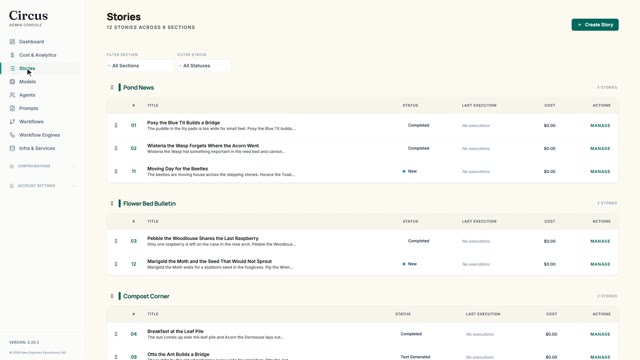
11:47
What is "the work", in Circus?
A plugin defines it. In the demo it's a story; in your business a lead, a listing, a document, an order — with its own pages and its own numbers. That is what we build for you.
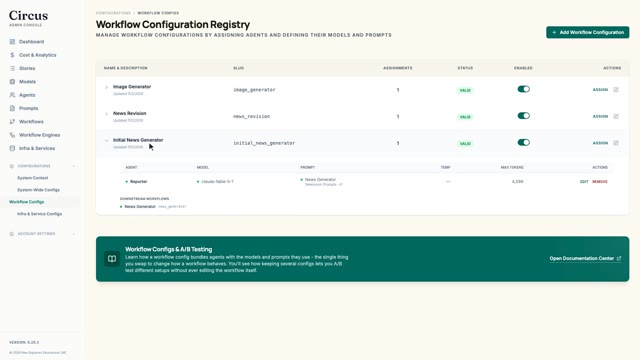
16:29
Is the cheaper model good enough?
Swap an agent's model in one screen, run the same work again, and read both results side by side, each with what it cost. Whether the cheaper one is good enough is your operator's call — now made on evidence.
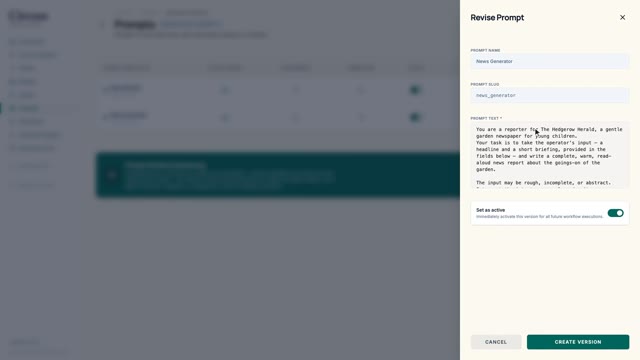
17:39
Change the instructions, not the workflow.
Prompts are versioned. Write a new version — a new rule, a different tone, a sharper brief — and the next run uses it, with no workflow edit and no developer. The old version stays, and rolling back is one click.
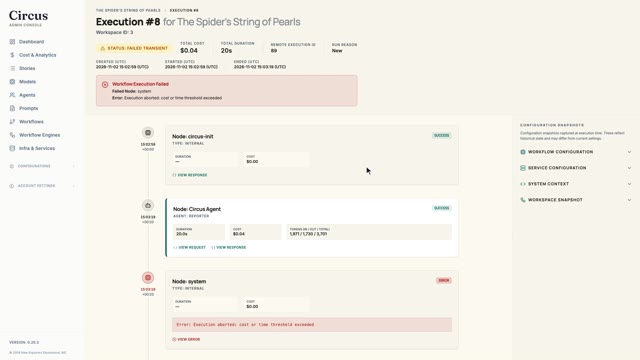
18:54
What stops a runaway bill?
Every workflow carries a time ceiling and a cost ceiling. Lower them, run again, and watch the platform stop the run and record what it had spent. Plus a stop button for the operator.
23 chapters
For the technical reader
The documentation is public.
The Circus documentation is written for five audiences: operators, ops engineers, architects, plugin developers, and workflow developers. The operator package is of most interest to your employees working on processes we automate for you. The other four are there for your own technical people, or the consultant you trust — so they can judge for themselves, from the engineering side, whether Circus deserves to run your work.
Read the documentation →Take action
Questions? Sure — we have time for you.
Talk to us before deciding on anything — thirty minutes, no cost, no deck. Or, if you already know, start.
Read next
How we work →
From first hello to the first automated process — what each step asks of you and gives you back.